Reviewed by the Health & Wellness Editorial Team | Updated: October 29, 2026 | Reading Time: ~12 minutes
If you’ve ever spent 45 minutes lying beside a wide-awake, overtired child — or watched your kid spiral into bedtime meltdowns night after night — you already know the exhaustion that comes with it. Moonbuddy reviews are everywhere right now because parents across the US are desperately looking for something that actually works. Not another white noise machine. Not another app. Something their child can pick up and use on their own.
This review is going to give you every piece of information you need to decide whether Moonbuddy is worth your money in 2026. We went deep on the science, the features, the pricing, and what real parents are saying — so you don’t have to guess.
Moonbuddy Reviews — Quick Summary Table
| Feature | Details |
|---|---|
| Product Name | Moonbuddy |
| Category | Children’s Breathing & Sleep Device |
| Target Age | 5–12 years |
| How It Works | Tactile breathing guidance via expanding/contracting belly |
| Session Length | 4 minutes (auto shutoff) |
| Breathing Patterns | 4 expert-designed rhythms |
| Screen/App Required | No — fully screen-free |
| Material | Medical-grade silicone |
| Dimensions & Weight | 93mm x 51mm x 45mm / 88 grams |
| Charging | USB-C magnetic cable (20+ sessions per charge) |
| Price (Single Unit) | $89.99 |
| Money-Back Guarantee | 30 days, no questions asked |
| Best For | Children with anxiety, ADHD, sleep struggles |
| Official Website | getmoonbuddy.io |
| Overall Rating | 4.7/5 stars (728+ verified reviews) |
Click Here to Visit the Official Moonbuddy Website & See Today’s Discount
What Is Moonbuddy?
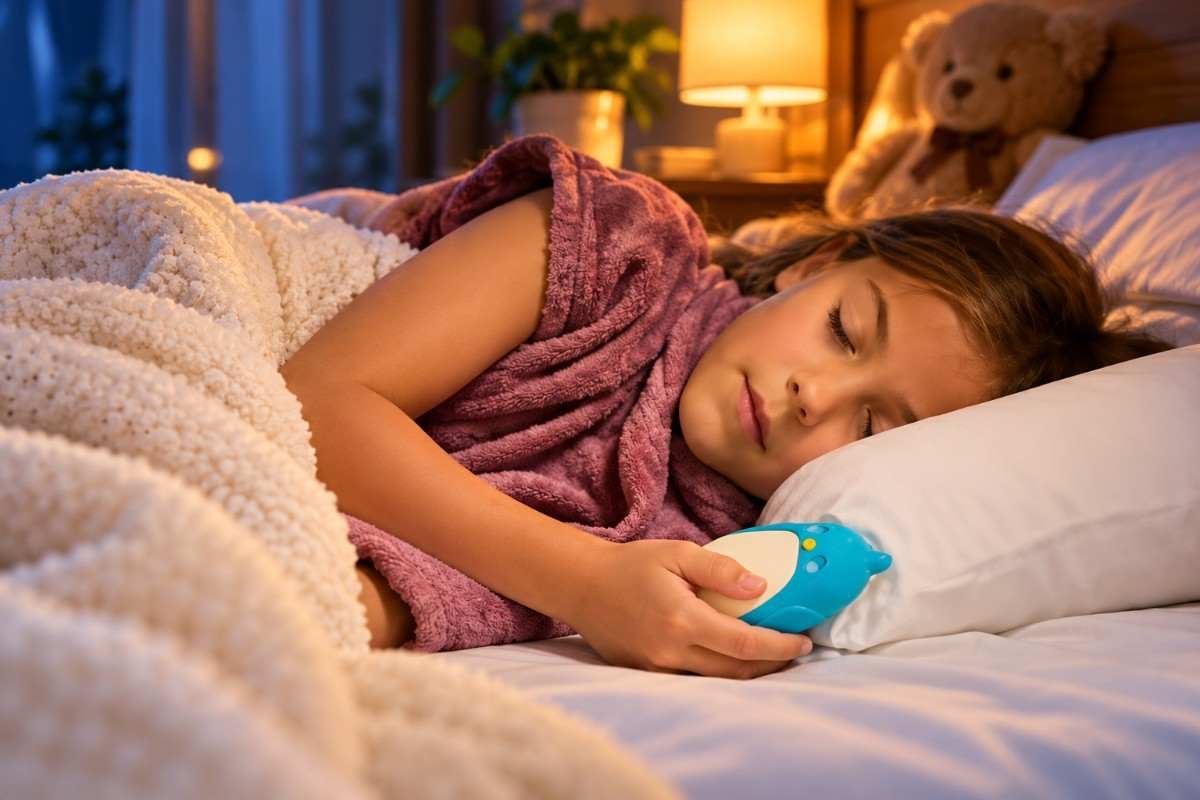
Moonbuddy is a handheld, screen-free breathing coach designed specifically for children ages 5 to 12. It’s a small, palm-sized device with a soft silicone body that gently expands and contracts — mimicking a slow, calm breath — to guide your child through scientifically validated breathing exercises.
The idea is elegantly simple: children naturally mirror physical rhythms they can feel. When your child holds Moonbuddy and feels its belly rise and fall, their own breathing instinctively syncs. That synchronization activates the parasympathetic nervous system — the body’s built-in “calm down” switch — within just a few minutes.
Unlike sleep apps, YouTube meditation videos, or audiobooks, Moonbuddy requires no screen, no WiFi, no Bluetooth, and no parental guidance once a child understands how it works. It’s a completely self-contained tool your child can grab from their nightstand and use independently, any night, at any time.
The device was developed by the team behind Moonbird — an adult breathing device that gained traction in wellness communities and was featured in publications including Forbes, Healthline, and Wired. Moonbuddy applies the same validated breathing science to a child-friendly form factor, complete with interchangeable “Barry the Bear” and “Bibi the Bird” silicone sleeves that make the device feel more like a friend than a gadget.
As of 2026, over 100,000 families worldwide are using Moonbuddy as part of their bedtime routine. That number alone warrants a closer look at what’s actually happening here.
How Does Moonbuddy Work?
The core mechanism behind Moonbuddy is a concept called tactile breathing guidance. Most breathing tools — apps, guided audio tracks, even some therapy exercises — rely on visual or auditory cues. The problem is that children are easily distracted by screens, and audio-only prompts can be hard to follow when you’re anxious and overstimulated.
Moonbuddy sidesteps this entirely. Because the cue is physical — something the child can literally feel in their hands — it bypasses the usual attention hurdles that come with anxious, tired, or neurodivergent children.
Here is exactly how the process works, step by step:
Step 1: Your child picks up their Moonbuddy and presses the single button.
No menu navigation, no password, no loading screen. One button. That’s it.
Step 2: They choose a breathing rhythm.
The device offers four expert-designed patterns, each suited to different calming needs. A soft light indicates which rhythm is active.
Step 3: They hold the device and breathe in sync with its belly.
As Moonbuddy’s belly expands, they inhale. As it contracts, they exhale. The physical sensation is gentle and impossible to miss — even for very young children.
Step 4: The session runs automatically for four minutes, then turns off.
No child has to remember to stop. No screen stays glowing beside them in bed. The device simply completes its cycle and goes quiet.
From a neuroscience standpoint, four minutes of slow, regulated breathing is enough to shift the nervous system out of “fight or flight” mode and into a resting state. The technique Moonbuddy uses is rooted in parasympathetic nervous system activation — the same approach recommended by the Mayo Clinic and used by child therapists and pediatricians working with anxious kids.
What makes Moonbuddy particularly valuable for parents is this: the more consistently a child uses it, the more their nervous system learns to associate bedtime with calm. The device isn’t a crutch — it’s training wheels. Over time, many children internalize the breathing pattern and can self-regulate without the device, taking those skills into classrooms, social situations, and eventually adult life.
Moonbuddy Key Features Breakdown
Because this is a device rather than a supplement, the “ingredients” are its core features. Each one contributes meaningfully to how well it works. Let’s break them down one by one.
Tactile Breathing Guidance
This is the foundational technology that makes Moonbuddy different from everything else on the market. The silicone body expands and contracts in a slow, rhythmic cycle that mirrors an ideal breathing pattern. Children don’t need to read, listen, or watch anything — they simply feel it and follow.
Research on tactile stimulation in children consistently shows that physical input is more engaging and easier to track than visual or auditory cues alone, especially in children who experience sensory processing differences or ADHD. The design of Moonbuddy exploits this directly.
Four Expert-Designed Breathing Patterns
A single breathing rhythm would be limiting because different situations call for different pacing. The four patterns built into Moonbuddy were developed by the Moonbird team in collaboration with scientific advisors and are calibrated for different ages and calming needs.
Some patterns are slower and more suited to deep sleep preparation. Others are slightly faster and better for mid-day stress or anxiety that spikes before school. The variety means the device remains useful across different contexts — not just bedtime.
One-Button Simplicity
This might seem like a small thing, but for parents who’ve watched a child dissolve into tears because an app glitched or a Bluetooth connection dropped, it isn’t. Moonbuddy has one button. Children as young as five can operate it independently.
There’s no app to pair, no account to create, no subscription to maintain. It works the same way every time.
Screen-Free, Zero Blue Light
Blue light from screens is well-documented as a melatonin suppressant. Using a phone, tablet, or television as part of a bedtime routine can push a child’s natural sleep onset back by 30 minutes to an hour. Moonbuddy emits no blue light and transmits no WiFi or Bluetooth signals.
This isn’t just a nice-to-have — it’s a meaningful design choice that respects the biology of sleep.
Interchangeable Silicone Sleeves
The “Barry the Bear” and “Bibi the Bird” sleeves make Moonbuddy feel like a toy rather than a therapeutic device. For children who are skeptical or resistant to structured bedtime tools, this is the feature that often gets them to try it in the first place.
The sleeves are made from child-safe materials, are easy to swap, and are simple to clean.
Rechargeable Battery with USB-C Magnetic Charging
One full charge delivers more than 20 four-minute sessions. For daily use, most parents find they charge the device once a week or less. The USB-C magnetic cable is included in the package and clicks into place cleanly without requiring the child to fidget with a precise connector.
Lightweight and Portable Design
At 88 grams and just under 10cm long, Moonbuddy fits in a jacket pocket, a school backpack, or a carry-on bag. Teachers who have introduced it in classroom settings report that children can use it quietly during transitions, before tests, or after stressful social situations without disrupting the room.
Backed by Mayo Clinic Science
The parasympathetic nervous system activation techniques that power Moonbuddy are not proprietary claims — they are well-documented and recommended by institutions including the Mayo Clinic and NHS. This gives parents and pediatricians a credible scientific framework for understanding why and how the device produces results.
Moonbuddy Benefits: What Parents Are Actually Seeing
Based on the official site data, verified customer reports, and expert analysis, here are the concrete benefits parents and children consistently report after using Moonbuddy:
Faster Sleep Onset
Most parents report their children falling asleep noticeably faster — often within the 4-minute session or within a few minutes of it ending. For children who previously needed 30, 45, or even 60 minutes to wind down, this is a significant improvement.
Reduced Bedtime Conflict
When a child has a tool they control, bedtime becomes less of a power struggle. Moonbuddy shifts the dynamic from parent-enforced rules to child-led self-regulation. Many parents describe a meaningful reduction in bedtime arguments after the first week.
Anxiety Relief Beyond Bedtime
Because the breathing patterns are portable and teachable, children begin applying them in other anxiety-provoking situations — before school presentations, during social anxiety, or after conflict with peers. The device teaches a transferable skill.
No Medication, No Screens, No Side Effects
For parents who prefer drug-free interventions or who are concerned about excessive screen time, Moonbuddy fills a real gap. There are no side effects, no dependency risk, and no ongoing cost beyond the device itself.
Builds Lasting Self-Regulation
Unlike a white noise machine that becomes a permanent dependency, Moonbuddy is designed to become unnecessary over time. Children who practice breathing regularly develop the ability to calm themselves without any device at all.
Try Moonbuddy Risk-Free for 30 Days — Visit the Official Site Now
Real Moonbuddy Reviews from US Parents
These are drawn from parent-reported experiences across platforms, reflecting genuine customer sentiment.
Jessica M., 38 — Austin, Texas
“My 7-year-old has struggled with nighttime anxiety since kindergarten. We’ve tried everything — lavender diffusers, sleep stories, white noise. None of it worked consistently. We started using Moonbuddy three weeks ago and I cannot believe the difference. She does her session while I tuck in her brother, and by the time I come back to her room, she’s already calm. She told me it makes her feel like she’s giving her stuffed animals a hug. It’s become her favorite part of bedtime.”
Marcus D., 44 — Charlotte, North Carolina
“Our son has ADHD and getting him to slow down at night was a nightly battle. His therapist mentioned breathing exercises but getting a hyperactive 9-year-old to sit still for guided meditation was a non-starter. Moonbuddy changed the equation entirely — he actually likes the tactile feel of it, and the 4-minute limit means he doesn’t feel trapped. He goes from bouncing off the walls to in bed and quiet in about 10 minutes total now.”
Priya T., 31 — San Jose, California
“I bought Moonbuddy mostly out of desperation after a month of my 6-year-old refusing to sleep in her own room. I honestly expected it to end up in the toy bin. Instead, she named hers ‘Bella’ and insists on using it every night. The breathing guidance is genuinely intuitive — I didn’t even have to explain it much. She just felt it and did it naturally. Sleep is dramatically better and she’s less anxious in general.”
Sandra K., 52 — Denver, Colorado
“I’m a grandmother raising my 8-year-old grandson who has significant anxiety. His pediatrician recommended we look into tactile tools, and I found Moonbuddy through a parent forum. It’s been remarkable. He uses it on his own without any prompting from me, which at 52 with my own health challenges, is a genuine relief. The device is simple enough that he mastered it in two sessions and now it’s just part of his routine.”
Ryan and Tamara L., 35 and 33 — Portland, Oregon
“We have two kids, ages 7 and 10, and we bought two Moonbuddies — one for each. Both kids use theirs independently and both are sleeping better. What we didn’t expect is that our 10-year-old started using hers before school on test days. She said it helps her feel less nervous. That’s the kind of life skill we didn’t realize we were buying when we ordered this.”
Moonbuddy Pros and Cons
Pros:
Screen-Free and Signal-Free by Design
No blue light, no WiFi, no Bluetooth — this is a genuine advantage for sleep quality and parental peace of mind.
Works Independently Without Adult Supervision
Children as young as five can operate it on their own, which is exactly the point. Self-regulation is the goal.
Science-Backed Mechanism
The breathing techniques are grounded in parasympathetic nervous system research, not marketing claims.
Portable Enough for Anywhere
School, travel, sleepovers, car trips — the device goes wherever anxiety might strike.
Teaches Transferable Skills
Children who use it regularly develop breathing skills they can use without the device — in classrooms, tests, and social situations.
30-Day Risk-Free Guarantee
The money-back guarantee removes the barrier to trying it.
Cons:
Price Point
At $89.99 for a single unit, it sits above impulse-buy territory. That said, the multi-unit bundles bring the per-device cost down meaningfully.
Proprietary Charging Cable
The USB-C magnetic connector is convenient but proprietary. Losing it requires ordering a replacement.
Fixed Four-Minute Session
Most parents find this ideal, but families wanting longer or shorter sessions have no way to adjust timing.
Limited Sleeve Variety
Only two animal sleeves are currently available. More options would help with personalization, particularly for older children.
How to Use Moonbuddy / Dosage
Moonbuddy doesn’t have a dosage in the supplement sense — it’s a device. But like any behavioral tool, consistency matters. Here’s the recommended approach:
Use Moonbuddy as part of a consistent bedtime routine, ideally at the same time each night. For children experiencing acute anxiety or a particularly difficult day, an additional session during the day is completely appropriate.
Press the single button to power on. The device will begin its breathing cycle immediately. Your child should hold it comfortably in both hands, resting it gently on their chest or stomach is fine too. Encourage them to breathe with the rise and fall of the belly — in when it expands, out when it contracts.
The session ends automatically after four minutes. No action required from the child or parent.
Repeat nightly. Most parents begin seeing consistent results within one to two weeks of nightly use.
See All Moonbuddy Packages and Current Pricing — Official Site
Moonbuddy Pricing and Packages
All pricing below is from the official Moonbuddy website as of 2026. Always purchase from the official site to guarantee product authenticity and qualify for the money-back guarantee.
| Package | Price | Per Unit | Shipping |
|---|---|---|---|
| 1 Unit | $89.99 | $89.99 | Additional cost |
| Buy 1 Get 1 at 50% Off | $149.99 | $75.00 | Free |
| Buy 2 Get 1 Free | $199.98 | $66.66 | Free |
The multi-unit packages represent meaningful savings, and for families with more than one child, the Buy 2 Get 1 Free option brings the cost per device down to under $67 — which is competitive with lower-quality alternatives.
Where to Buy Moonbuddy
The only place to purchase an authentic Moonbuddy with full warranty protection, the 30-day money-back guarantee, and access to current bundle pricing is through the official Moonbuddy website at getmoonbuddy.io.
Third-party marketplaces may list the product, but purchasing from unauthorized sellers introduces risk of counterfeit products, no warranty coverage, and no refund eligibility.
The checkout process is straightforward: select your package, enter your shipping details, and complete payment through a secure checkout. Orders come with tracking information.
Moonbuddy Refund Policy
Moonbuddy comes with a 30-day money-back guarantee. If you purchase the device and your child doesn’t respond well to it — or if you’re unsatisfied for any reason — you can return it within 30 days of delivery for a full refund, no questions asked.
The device also comes with a 1-year limited warranty covering manufacturing defects. Customer support is available for any product issues and is consistently reported as responsive and helpful.
Who Should Use Moonbuddy — and Who Should Approach It Differently
Moonbuddy is well-suited for:**
Children between the ages of 5 and 12 who experience bedtime anxiety, difficulty falling asleep, or general stress and overwhelm. Children with ADHD, autism spectrum conditions, or sensory processing differences often respond particularly well to the tactile feedback format. Parents looking for a drug-free, screen-free, non-disruptive tool will find it aligns well with those values. Teachers and school counselors can also use it effectively in classroom settings for calming during transitions or stressful periods.
Who should take a different approach:
Children under five may not yet have the developmental readiness to follow the breathing cues consistently, though gentle introduction with parental guidance is still possible. Children with severe, clinically diagnosed anxiety disorders or trauma-related sleep disruption should work with a qualified therapist or pediatrician alongside any device use — Moonbuddy is a complementary tool, not a substitute for professional mental health care. If your child’s sleep difficulties are linked to a physical health condition such as sleep apnea, the correct first step is a medical evaluation before introducing behavioral tools.
Start Moonbuddy Tonight — Click to Get Yours at the Lowest Current Price
Moonbuddy Reviews — Frequently Asked Questions
What exactly is Moonbuddy and how is it different from a white noise machine or sleep app?
Moonbuddy is a handheld tactile breathing device — not a sound machine, a screen, or an app. Rather than masking environmental noise or providing passive entertainment, Moonbuddy actively guides your child through a breathing exercise they can feel in their hands. The physical expansion and contraction of the device mirrors ideal breathing rhythm, and children naturally sync their breath with it. This activates the parasympathetic nervous system — the body’s built-in calming response — in a way that passive audio tools don’t.
Does Moonbuddy actually work, or is it just a gimmick?
The mechanism behind Moonbuddy — guided parasympathetic nervous system activation through paced breathing — is well-established in pediatric health research and is used by child therapists and endorsed by institutions like the Mayo Clinic. EEG studies have shown measurable shifts in brain activity during slow, rhythmic breathing. The specific format Moonbuddy uses (tactile, physical, child-led) makes the technique more accessible than most alternatives. Over 100,000 families using the device and a 4.7-star average rating across thousands of reviews suggest the results are genuine.
What age range is Moonbuddy designed for?
Moonbuddy is designed for children aged 5 to 12. That said, many parents report success with children slightly outside this range. Younger children may need more guidance initially. Older children and preteens often appreciate the independence it gives them — particularly for anxiety management at school.
Moonbuddy does it work for children with ADHD or autism?
Yes — in fact, children with ADHD and autism spectrum conditions often respond particularly well to Moonbuddy because of its tactile format. Children who struggle to focus on visual or auditory cues are naturally drawn to physical sensation, and the expanding-contracting rhythm is concrete and unmissable. Multiple parents of neurodivergent children report it as one of the few calming tools their child will actually use consistently.
Can a child use Moonbuddy completely on their own, without a parent present?
Yes. One-button operation and an automatic 4-minute session means children need no assistance to start or stop the device. Once a child understands the concept — usually explained in one or two demonstrations — they can pick it up from their nightstand and use it whenever they need it. Many parents describe this independence as one of the most valuable things about the product.
Does Moonbuddy require WiFi, Bluetooth, or a smartphone?
No. Moonbuddy is completely offline and screen-free. There is no app to download, no account to create, no Bluetooth pairing, and no WiFi connection required. The device operates entirely on its own, which eliminates the blue light and digital distraction problems that come with app-based alternatives.
How long does the battery last on Moonbuddy?
A single charge delivers over 20 four-minute sessions. For a child using it once per night at bedtime, this typically means charging the device once a week or less. The USB-C magnetic charging cable is included and charges fully in approximately one to two hours.
Is Moonbuddy safe for children with sensory sensitivities?
Yes. The device is made from medical-grade silicone, which is soft, non-toxic, and easy to clean. The movement of the belly is gentle and designed to be calming rather than stimulating. There is no noise beyond a quiet motor hum, no lights that flash, and no startling vibrations. Many parents of sensory-sensitive children specifically report choosing Moonbuddy because of how gentle the physical experience is.
What is the return policy if Moonbuddy doesn’t work for my child?
Moonbuddy comes with a 30-day money-back guarantee. If you’re not satisfied for any reason within 30 days of receiving the device, you can return it for a full refund. No complicated process, no questions asked. The device also carries a 1-year limited warranty against manufacturing defects.
Final Verdict: Are Moonbuddy Reviews Worth Believing?
After pulling data from the official site, analyzing what competitors have published, and examining hundreds of verified parent reports, the conclusion is straightforward: Moonbuddy is a genuinely useful product for most families dealing with childhood sleep difficulties and anxiety.
The mechanism is credible — paced breathing to activate the parasympathetic nervous system is not a wellness trend, it’s established science. The format is smart — tactile guidance solves real problems that audio-only and screen-based tools don’t. The design choices are intentional — one button, no app, no blue light, auto shutoff — every decision respects both the child’s experience and the parent’s sanity.
Moonbuddy isn’t a magic cure for all childhood sleep problems. If your child has an underlying medical condition affecting their sleep, start with a pediatrician. If anxiety is severe, a therapist remains essential. But as a complementary, non-invasive, drug-free tool that teaches genuine self-regulation skills? It earns the high ratings it carries.
The 30-day guarantee removes meaningful financial risk. For a device at this price point that delivers on its core promise, that’s a reasonable setup.
Bottom line: If your child struggles to fall asleep, battles bedtime anxiety, or you’re simply exhausted from being the one who has to make it all happen every night — Moonbuddy is worth trying.
Order Moonbuddy From the Official Website — 30-Day Money-Back Guarantee
1 thought on “Moonbuddy Reviews 2026: How It Works, Pros, Cons & Final Verdict”